

Toxic Maidenhood
Or, The Red Pill for Girls: why dating is fake and gay.

Warning: This post may contain strong language (“My freakin’ ears!”), Adult Situations, and unsentimental characterizations of men and women as chimps.

“Every vice was once a virtue, necessary in the struggle for existence; it became a vice only when it survived the conditions that made it indispensable; a vice, therefore, is not an advanced form of behavior, but usually an atavistic throwback to ancient and superseded ways.”
—Will Durant, Our Oriental Heritage
If there’s one thing that people like to talk about, it’s women. It’s also one of those topics where, if you don’t do an Indiana Jones-style skip-hop dance and spell I-E-H-O-V-A with your feet while dodging flying arrows, you will be decapitated piss everyone right off. So that’s what we’re going to talk about today.
We live in the world of the Eternal Maiden.
Women naturally pass through three stages in life—maiden, mother, and crone matriarch.1 What happens when society enshrines the virtues of the maiden only and deems the other two stages unnecessary or even unwise? You get what we have now: a society where motherhood is seen as downwardly-mobile if it happens any time before age 32 and where taking care of your own kids and household is a considered a weird and mind-numbing hobby for the mentally soft, like needlepoint or Sudoku.2
(As for the other stage? It’s so unthinkable that I’m going to spend the next 8,000 words working my way up to discussing it.)
Online, there’s a greater variety of opinion, and I regularly come across articles with interesting and insightful takes on women. Is motherhood really low-status, and is there some way to rehabilitate it? Do wives owe their husbands sex? Why are young men so weirded-out by Wifejak?
In person, the acceptable range of opinion on women is somewhat more limited.
Blue-pilled take (liberal or libertarian): Women are amazing and all the choices they make are valid!
Red-pilled take (conservative): Women are amazing, and being a wife and mother is amazing! But, I mean, of course all choices are valid. I’m not some kind of misogynistic monster. …Not like that other guy, whom you should definitely not sleep with. I guess I’m just saying that I really respect women. Hey, do you want to grab a coffee sometime?
The key word is choice. When choice, rather than obligation or duty, is our societal North Star, we cannot meaningfully give advice to young women anymore. The most we can say is that they should maximize choice at the cost of every other value.
I’ve seen this dynamic play out in person. No one wants to say, “You should avoid dating, get married young, and have kids, and then, you know, take care of them.”3 It’s much easier—and more well-received—to say, “Motherhood’s not for everybody! You should follow your dreams/build a sensible career/travel the world and sample a variety of men food!” Telling them that they should be lawyers, CEOs, or TikTok influencers will garner far less resistance. Imagine being a teenaged girl and receiving this advice from a mom with unbrushed hair, a shirt full of mystery stains, and a sticky-faced toddler yanking at her hand. “It’s too late for me,” she seems to be saying, “But you can still save yourself!”
For all the apparent lip-service paid to how great women are, this kind of advice fundamentally de-values and rejects women’s tripartite nature and replaces it with the Hero’s Journey. Mary Harrington describes it thusly:
By framing women’s liberation as a matter of unpicking us from relationships, and sidelining the three archetypal stages of womanhood, we end up imposing a male-standard Hero’s Journey on women - where you set forth on your own, vanquish demons and dragons, and return with the prize - that for many is not a comfortable fit with how life actually plays out." (From her excellent article “The maiden, the mother and…the other one.”)
People have started to notice that many of the popular romance books written for women appear to be thinly-veiled porn. But there’s another literary genre that, while certainly less pornographic, also contributes to this problem: the young-girl-goes-on-an-epic-quest and becomes the Hero. These are books—usually aimed at aunts who don’t want to buy their nieces Twilight or A Court of Thorns and Roses—in which the traditionally male coming-of-age story (the Hero’s Journey) is essentially grafted onto some female protagonist: learn to wield a sword, slay the dragon, save your village. It’s a wholesome narrative to which no reasonable person could possible object…right?
The problem is that it feeds into a false dichotomy in which young women must choose the low-status, hyper-sexualized path of the Minotaur Milker4 or the one their parents prefer: the Unsexed Girl-LARPing-as-A-Guy Hero’s Journey path. We don’t often see the mother at the center of popular culture because, to be perfectly honest, she’s boring AF. That’s a feature, not a bug: uninteresting moms are the backbone of society. But you can’t make movies about such women.
Don’t believe me? Consider the popularity of a movie like Mamma Mia!, in which the lesson appears to be that getting married when you’re still young enough to have kids is a sad trap for boring losers and way less fun than traveling the world (oh, and romantic intrigue is reserved for a high body-count post-menopausal Meryl Streep). This movie enjoys evergreen popularity among women of pretty much all ages, part of which is due to the liberal application of ABBA songs, and part of which is due to its almost farcical reverence for choice (and also not knowing which of three (!!!) men impregnated you).
Recent movies (those made in the last 25 years or so) aimed at women seem to follow one of two arcs:
(1) “Who wants stability when you can have the mystery box?” I was going to settle down with a boring, loyal, predictable guy, but now I realize that I should go off and have adventures5 with this other, less predictable guy (who will probably leave me before the credits are done rolling).
(2) “I guess I’m all ho’ed out now.” Well, I’ve been dating irresponsible cads for the past 15 - 20 years, so I guess now it’s time to spend a tight 110 minutes exorcising my fear of abandonment so that I may commit to this unrealistically wealthy, handsome, and non-octogenarian man. (A subtype of movie is one in which the plot arc follows this until the last third of the movie, at which point we get the equivalent of “psych! never mind, I’m not settling down.”)
Girls don’t want to hear you tell them that the most prudent thing to do would be for them to marry a guy who is reasonably attractive6, responsible, has a good working relationship (warm but not smothering) with his family, and will be able to hold down a job and provide for you for the next forty to sixty years.7 You may as well just say, “Hi! You’re going to get old and die. Here are some boring and difficult things you can do in the meantime.”
Even moms who have committed to this path themselves don’t want to give this advice. I’ve found that, when such opportunities arise, three basic types of mom appear:
(1) The Cool Mom (“I’m not like a regular mom. I’m a cool mom!”) This is a woman who always felt like she was too good (read: too smart/too talented) for motherhood. Being a mom is the least favorite part of her identity, and she has a fridge covered in ironic 1950s-parody magnets to prove it.
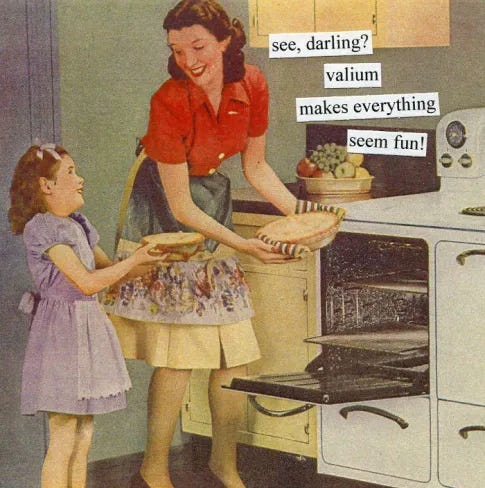
(2) The Afraid-to-be-Uncool Mom (“I do, in fact, have the secret to a fulfilling life…but I’m sure you wouldn’t be interested in hearing about that.”) They love motherhood and genuinely think it’s the most important thing they’ve ever done, but they don’t want to come off as preachy or pushy. Starting in the early 2000s, there have been a regular cycle of articles decrying—for lack of a better word—pro-natalist sentiment. These articles all featured the same caricature of the fertility proselytizer: the tone-deaf, slightly inebriated aunt with whom you must politely interact once a year at the family Christmas party. Nobody wants to be associated with the pushy middle-aged woman who keeps demanding why you haven’t procreated yet.
(3) The Saboteur: A mom who has made some questionable life decisions before, during, and/or after having kids8 and who now wants to sabotage her younger rivals. (Maybe she’s even back on the dating market and looking to undercut the competition.) Yes, you should sleep around! Any man secure in his masculinity won’t mind. Also, you should get that pixie cut and never shave your legs. Don’t you know that men find women with that kind of confidence irresistible? These women ensure that young women will fritter away their youth on alpha cads who treat them as temporary members of a harem.
If you think I’m exaggerating, then try finding an average group of women—that is, ones who aren’t wearing floral hand-sewn ankle-length dresses and have 3 feet of hair—and telling them that they shouldn’t let their teenaged daughters go on dates. You generally get a better reception if you insist that their daughters should go college (or trade school), get a professional degree, and not consider settling down until their thirties.
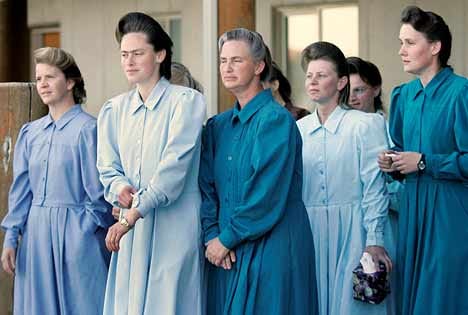
Some of the worst offenders (the most pro-feminist, anti-marriage boosters) are women who got married in their twenties, had kids, and have nominally stable marriages. For some reason, these women seem especially eager to prove that they’re Not Like Other Moms. They say things like: “I’m not teaching my daughter to be dependent on a man!” and “She needs a career to fall back on in case her husband leaves her!”
These women have drunk the Toxic Maiden Kool-Aid, and they’re not looking back.
Maidenhood
Most women start out as self-obsessed, shallow, and generally useless.
Hang on a minute! you say. That describes how everybody starts out, male or female. You’re right, of course. So why am I picking on women? Because I left out an important fact: in spite of these traits, society values women.
Note: by values, I don’t necessary mean treats well. I mean regards as possessing inherent worth; something to be acquired and guarded.
This is not the case for men. Growing up, they are basically worthless to anyone outside their immediate family. Their families, of course, hope that they will one day grow up to be fine, upstanding members of the community who are then able to acquire a wife and contribute to the family bloodline. But nobody wants their daughter to marry a man who hasn’t proven his worth in some regard: he at least needs to demonstrate that he has the potential to be a good provider. He must be a chimp capable of bringing home an adequate pile of bananas.
Our expectations for women are…slightly lower.9
The Maiden is—with rare exceptions—a sub-clinical narcissist. That’s not a bug; it’s a feature. This the public-facing phase of her life, a fact of which she is very aware. She is possessed of a powerful but transient beauty. The fact that it is unearned is beside the point (at least for now). She is experiencing the equivalent of what happens when someone wins the lottery (or inherits a fortune) and suddenly all of his distant relatives come out of the woodwork, hoping to get a few dollars thrown their way.
She grows accustomed to intense scrutiny and interest at all times—even if she’s not particularly pretty. She cannot go out in public without being sized up as a potential mate (keeping it PG-13), a feeling which can be disconcerting or thrilling, depending on the quality of the sizer-upper. A woman’s greatest evolved fear is to be impregnated by a weak male (that is, one who is unable to keep her and her baby alive). Feminism’s greatest trick, in case you’re wondering, is to lie about this fact.
The Maiden careens wildly between extremes of self-consciousness and exhibitionism. She has a strong biological pressure to maximize both her desirability and the time spent being seen by eligible mating prospects; but in order to achieve the latter goal, she must plough through a gauntlet of unattractive male prospects. She is vain, volatile, and programmed to treat the undesirable males in her life with a callousness that borders on cruelty.
We shouldn’t judge her too harshly. She is responding to natural biological impulses (teenaged boys have them too), and it is society’s job to channel and moderate these impulses. She herself is not capable of doing so herself. Besides, this phase of her life, while somewhat obnoxious to those around her, is temporary. (Well, it used to be; more on that later.)
The Crucible of Motherhood
Motherhood is, in many ways, the opposite of maidenhood.
Where maidenhood was public, motherhood is private. Your audience of admirers (or at least sizer-uppers) goes from the entire post-pubescent male population to a single man: your husband. Yes, you will serve as the center of the universe for your children, but that position requires selfless toil, sleep deprivation, and above all, the enormous weight of responsibility that comes with being the caretaker of a small human being.
Where maidenhood offered unbounded choice, motherhood is obligation. It represents the commitment to a path from which one can no longer deviate. Daydreaming about the kind of man you might marry or the kind of lifestyle he will provide for you is now a thing of the past; you’ve picked the horse (or in more traditional societies, your parents have) and his fate is yours, for better or for worse. This is an enormous upheaval for many women. For some, it’s nothing short of traumatic.
There is a subset of women whose entire identity depends on being seen by men. These women are generally incapable of transitioning from Maidenhood to Motherhood; in societies where the bonds of marriage are enforced, they endure lives of perpetual dissatisfaction, chafing against the restrictions of married life. Rarely do they simply accept this fate: these are the women who grasp at any opportunity to flirt with other men, the ones who demand to be taken somewhere that allows them to show off their assets.10 They’re the ones who love the idea of the wedding, but cannot fathom the reality of the marriage.
Unsolicited advice to single men: avoid women who are obsessed with weddings. Everyone in my generation (or older) grew up knowing girls with a sort of wedding mania. They were the ones who planned everything down to the most minute detail, from the length of the veil (did you know that there’s such a thing as a veil consultant?) to the font on their wedding invitations. They’re the ones who used to cut out pictures from various magazines and make scrapbooks; nowadays, they have a meticulously curated Pinterest board.
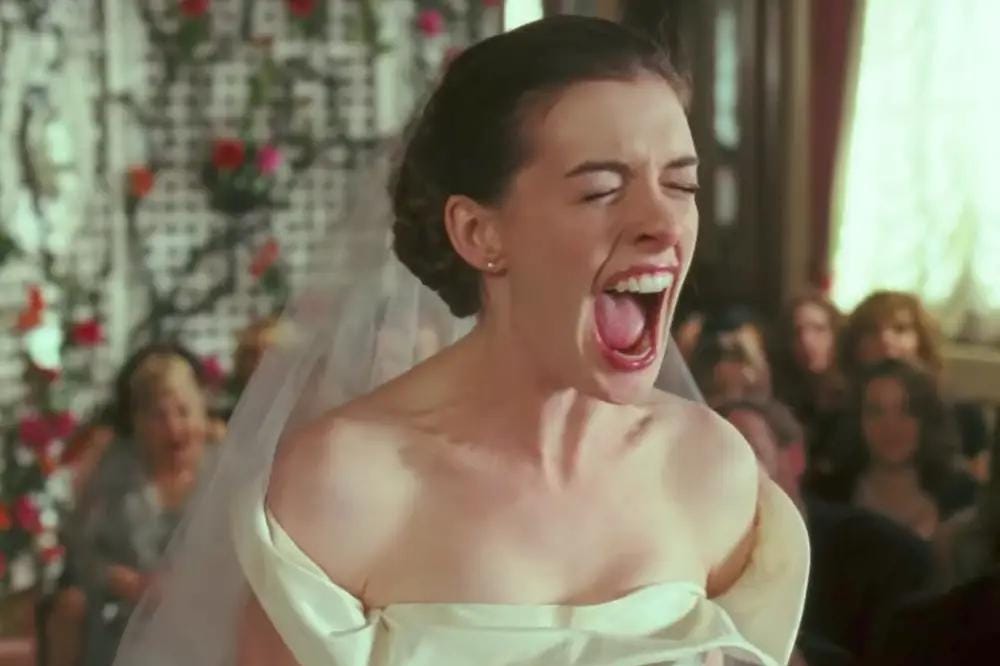
Women like this11 are among the least happy in their marriages (and the most likely to get divorced). The reason for this is simple: the Wedding is the ultimate experience of being seen, the public culmination of the Maiden’s Journey. The bride is the center of attention, the heroine of the Fairy Tale. She wants everyone in attendance to behold the quality of the Resource-Provider-Chimp she has acquired.
Marriage is the opposite of your wedding day. It is characterized by routine, unglamorous tasks done on behalf of generally ungrateful (albeit adorable) recipients, and in front of a much smaller audience. Your vast horde of admirers has dwindled to one guy. Your husband is now president, vice-president, treasurer, and secretary of your fan club.12
The wedding is, in a very real sense, the Maiden’s funeral. It’s the last time she is seen in public before being chained to the kitchen radiator entering a life spent mostly in the company of her family (and female friends, who don’t count!) It is a type of ego death that prepares the way for the next phase of her life: Motherhood.
Motherhood, in some ways, belies explanation. If you try to quantify it—see this valiant attempt—it looks really, really bad on paper: the equivalent of a car loan at 37.8% APR. You go from an ostensibly free individual who is valued for doing absolutely nothing other than displaying her presumed fertility (i.e., being youthful and attractive) to a far more humble creature whose body has been hijacked for the sole purpose of serving others. This service begins with the use of your body as the manufacturer, incubator, and delivery mechanism for another human being (sorry, sometimes you just have to go Full Autism), a process that will be repeated until you reach menopause.
Oh, and you might die. Going into pregnancy and childbirth is like having Nature hand you one of those really unsettling Liability Waivers that says something like, “Nature, Inc. will not be held responsible in cases of death and/or dismemberment.” If you survive this ordeal, you get to move on to phase two, in which 80 - 90% of your waking hours will involve dealing with some sort of bodily fluid.
And that’s just the physical stuff. Once you have children, you have, as the saying goes, given hostages to Fate. You have sent out into the cruel, uncaring world a living being more precious to you than life itself. You don’t get them back. They were never yours to begin with, not even (if you’re a woman) when they were in the womb and you could feel their tiny feet pressing against your ribcage. Now you are expected to offer them up like a sacrifice on the altar of Life, where they will experience heartbreak, unfathomable pain, and crushing loss. When you inevitably die, they will have to say goodbye to you, and long after you’re gone, they will continue to lose the people closest to them. And then they’ll die, too.
That’s the best-case scenario. We need not discuss worse outcomes. Every mother—and father—has either experienced these, or knows someone who has, and will never experience another night of sleep free of those dark premonitions.
This is why I describe motherhood as a crucible through which one must pass to fully experience adult womanhood. There are, to be sure, other meaningful vocations in life for women who do not have children. But for most women, motherhood is the admission ticket that grants them first-row seats to the mysteries of the universe. It is the first time they realize that they are willing to die for someone. After spending maidenhood in timidity and risk mitigation mode, motherhood offers a glimpse into the deepest, most cavernous reserves of strength and fearlessness. Virtually all women are improved by motherhood.
Caveat: Yes, there are some terrible, narcissistic mothers out there. Somehow, they emerged from this crucible with their souls still misshapen and half-formed. Just because these women exist, though, doesn’t mean that motherhood doesn’t generally serve a purpose.
Second Caveat: Yes, I know there are some generous, selfless, and strong women who are childless—women who developed the kinds of traits that usually require the gauntlet of motherhood to achieve. In some cases, they went through a crucible of their own; in others, they were simply born this way. My insistence that women are improved by motherhood is not meant to denigrate these women.
What comes after Motherhood? Matriarchy, or the dreaded C-word. But that’s a scary topic for those of us who haven’t yet gone through that passage, so I’m going to save it for later.
For now, I’d like to talk about men.
Male Cooperation and Paternity Uncertainty
Why can’t women freely roam the Savannah, flaunting their long hair, trad sundresses, and Instagram-filtered “no makeup” faces?
Short answer: Because men will look at them.
Slightly longer answer: Because men will look at them, and this will cause conflict with other men. In order for us to have a reasonably complex society—and the nice things that come with it, like safety, order, and air-conditioning—men need to be able to cooperate with one another. Specifically, they need to be able to cooperate with men outside of their immediate families.
Men compete with one another for women. If there are no consequences—and sometimes even if there are—they will take another man’s wife. They are, at the most fundamental level of their programming, aggressive jerks who want things and who will take those things from other men if nobody stops them.
Don’t worry: I’m not letting women off the hook. Women—as anyone who has been on the Internet since the Great Red-Pill Awakening knows—are naturally hypergamous.13 Just as men have an inborn instinct to spread their genetic material as far and wide as possible (sorry, terrible visual, I’m reaching for the brain-bleach as I type), women have a natural instinct to mate with the best available man.14
Thus, when a man acquires a wife, it is generally imprudent to allow her to continue to interact freely with other men. It may sound harsh, but consider this: even if his wife is a paragon of virtue and would never consider responding to another man’s advances, the male competitive instinct itself will be a problem. Men need to be able to trust other men…but they also know what other men are like. If a man is constantly worried about other men vying for his wife’s affections (or, you know, hijacking her uterus for his own genetic advantage), he will be unable to effectively cooperate with them. Society as a whole loses when men have to wonder whether their wives are having 2-martini lunches with some guy who looks like Don Draper.15
During both Maidenhood and Motherhood, women are visibly fertile, as in: they do not appear to be in menopause yet and could therefore, in theory, bear viable offspring. That makes them—in the eyes of men’s biological programming—resources. They are, if you’ll forgive the unnecessarily autist turn of phrase, Fertile Units. They have value simply by virtue of who they are. And that means they’re worth stealing. Or worse—borrowing.
Yes, one of Nature’s cruelest tricks (if you’re a man) is that, up until recently, it was impossible to know for certain whether the child coming out of your wife was yours. And, being a man—self-knowledge can be a painful thing—you are aware that you cannot put it past other men to impregnate your wife when you’re not looking. In which case you will have been tricked into spending your resources on someone else’s offspring. The problem of Paternity Uncertainty is even greater than the problem of outright theft of someone’s resource wife, because if left unsolved, it will lead to men not being willing to invest in the offspring of the women they impregnate. They’re not going to spring for so much as three meals a day for the kid, let alone someone to tutor them in the canons of rhetoric.
So if you want to keep your Fertile Unit from being unceremoniously carried off to Troy, then you need to keep her away from the kind of people who are always in the market to test test-drive, rent, or purchase a new Fertile Unit. Unfortunately, that population includes—in theory—every post-pubescent male in the entire world.
All of this has the potential to lead to unmitigated chaos: ‘roided-up chimps engaged in a constant war of all against all (à la Hobbes) and women ending up as part of a rotating harem belonging to the Alpha Chimp of the moment.
It turns out that your preschool teacher was right after all: the most important thing in life is cooperation.
Solutions, or Why We Can’t Just Unchain Women From the Radiator
In order for men to cooperate with one another, they need to trust that the men with whom they’re cooperating are not [redacted]-ing their wives behind their backs.
The extreme version of this is purdah: the total seclusion of women either through physical isolation or bodily coverings like the burqa. The word conjures up places like Saudi Arabia, but one might also imagine ancient Athens, where women were relegated to the second floor gynaeceum (γυναικωνῖτις) while their husbands got to have long, wine-soaked symposia where they could trade erotic poetry while being serenaded by flute-boys. Society needn’t go that far. It can enforce rules of propriety and modesty without creating a situation where men start giving those flute-boys and cup-bearers a second look.

Don’t get me wrong: physical separation of the sexes is an important component of sexual morality.16 Convenience and inconvenience are powerful tools in behavior modification, and as anyone who’s ever gone on a diet knows, willpower only gets you so far (e.g., to about 4:45 P.M.). But keeping the opposite sex out of arms’ reach isn’t the only thing we’re talking about here. It’s not even really the most important thing. What we’re really talking about is a culture of motherhood.
Motherhood, when you get right down to it, is really just a centering of the woman’s life in the domestic sphere. She is the center of her children’s lives; she’s a stable point in the family solar system. In order to fulfill that promise, she cannot be constantly on the lookout for outside attention from men.
This doesn’t require isolation. In a healthy, tight-knit community, motherhood means being part of a network of neighborhood moms as well as older women, in which one may share the tasks—both pleasant and unpleasant—of child management and the enforcement of community morals in general. In such an environment, women have conversations and laugh and do things together; they watch each others’ children; they trade war stories and wisdom. (Whether these relationships rise to the level of actual “friendship”—in the robust sense described in Cicero’s De Amicitia—or mere acquaintanceship is a matter I will leave for another day. There are those who argue that many (most?) women are not capable of genuine friendship, and on most days, I agree with them.17)
She can’t do this with men; at least not straight men. C.S. Lewis, who allowed for the possibility of male-female friendships under certain circumstances, noted:
It is only the riff-raff of each sex that wants to be incessantly hanging on the other.18
Motherhood as a socio-sexual identity ends when a woman is no longer visibly fertile. In plainer terms (sorry), it ends when a man no longer sees her as someone worth trying to impregnate.
This used to happen earlier. Various cosmetic interventions from hair dying to Botox to plastic surgery now regularly extend a woman’s years of appearing fertile. Will Durant, writing in 1929, observed:
“We cannot be too grateful to her for the sly arts by which she preserves her seductive charms to an age which brought the ladies of the past centuries to the first stages of senility. Once a woman of forty was old, decrepit, and trustworthy; today there is nothing so dangerous."19
Eventually, of course, the abundant coffers of youth run dry. The time of the Crone is nigh. We will give her her due. First, though, we need to discuss our current predicament.
Toxic Maidenhood
Maidenhood is not inherently a bad thing. It is, from Nature’s perspective, a means to an end. The problem is that we are now living in the age of Eternal Maidenhood.
But women don’t want to stay maidens in the traditional sense; no one is clamoring to live under the absolute authority of the paterfamilias. Nor are they running off to sign up for a 30-year stint as Vestal Virgins. Maidenhood, as we discussed above, has been reconstituted as a phase of life in which maximum freedom has been paired with minimum responsibility.
This is Toxic Maidenhood. It is a warped simulacrum of actual maidenhood, and it is sold to women as a permanent identity. It is characterized by:
(1) Sexual license: women are encouraged to engage in consequence-free sex20 with as many partners as they would like.
(2) Freedom from unchosen obligations: a woman owes nothing to anyone, except herself.
(3) Independence: women are encouraged to reject relationships involving dependence (e.g., stay-at-home mom).
Most mainstream mothers seem to accept the premises of Toxic Maidenhood (they may even adhere to its principles themselves). They encourage their teenaged daughters to date and go on birth control. They insist that their daughters should consider only their own desires and ambitions in deciding what to do with their lives. They save their strongest dose of moralizing for the issue of financial independence: you need to get a degree and have a career, they tell their daughters, so that you may never be dependent on a man.
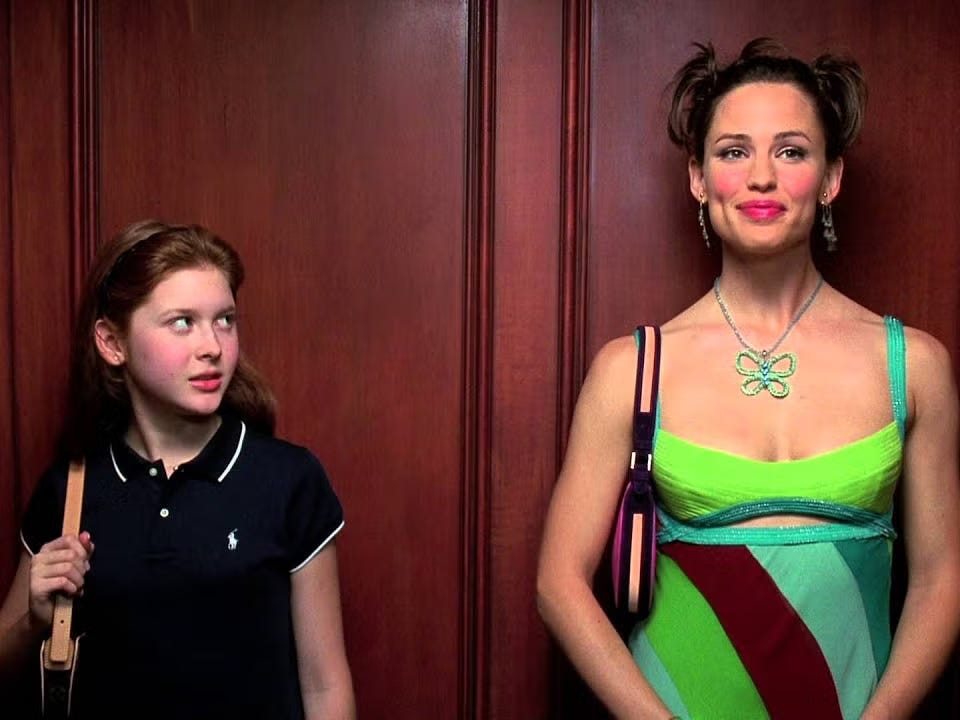
In other words, they want their daughters to turn into Jennifer Garner in the movie 13 Going on 30. She’s “thirty, flirty, and thriving.” She is living her life with the income and autonomy of an adult, but none of the attendant responsibilities.
Do moms do this because they hate their daughters? No (not usually, anyway). But Normie Moms are status-conscious, and all three of these pieces of advice are high-status. A moderate amount of casual sex; motherhood delayed or foregone entirely; a lucrative, fulfilling career or less-lucrative-but-still-fulfilling vocation, like, I don’t know, Van Life. Marrying young—rather than experiencing years of dating (to put it euphemistically)—having children in your twenties, and depending financially on your husband is coded as low-status. (Only those with ostentatious amounts of wealth may pursue these avenues without looking poor and trashy.)
It’s not just that Maidenhood has turned into an eternal diversion that extends well past youth; it’s that Maidenhood itself—even experienced at the proper age—has become perverted. The function of Maidenhood is to advertise that a young woman is now marriage material (which is to say: capable of bearing children). This might be a low-key affair, in which parents quietly confer with families in possession of eligible young men. Some communities have formalized the role of “matchmaker” or follow a custom of arranged marriages. In wealthier societies, we find institutions like the “Debutante Ball,” which served to notify the community that one’s daughter was in the market for a husband.
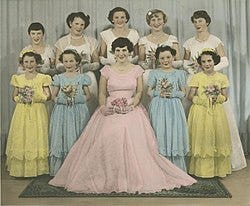
All of these institutions and customs served to do one thing: regulate the manner in which sexual maturity could be advertised.
Why have such restrictions? (“Why can’t young people decide these things for themselves?!” Well, if I’ve learned one thing from Fiddler on the Roof, that classic paean to ethnic fidelity, once you let your daughters choose their own husbands, it’s a short journey from “dorky tailor we’re not too thrilled about” to “commie upstart” to “religio-ethnic enemy.”21). These restrictions reflect biological reality: advertising one’s sexual maturity, in the state of nature, inevitably leads to someone taking you up on that offer. Your father isn’t trying to ruin your life; he just wants to ensure that you don’t end up raising a bunch of children in husband-less destitution.
This involves safeguards like: no unsupervised mixing between the sexes and modesty in dress and conduct on the part of girls. These safeguards are intended to lower the probability of someone claiming your resource daughter by force (without your permission), an act which, like driving a new car off of the dealership lot, causes an immediate and irreversible loss of value.
What happens when these structures are removed? Modern dating, that’s what.
The Dating LARP, or The Red Pill For Girls
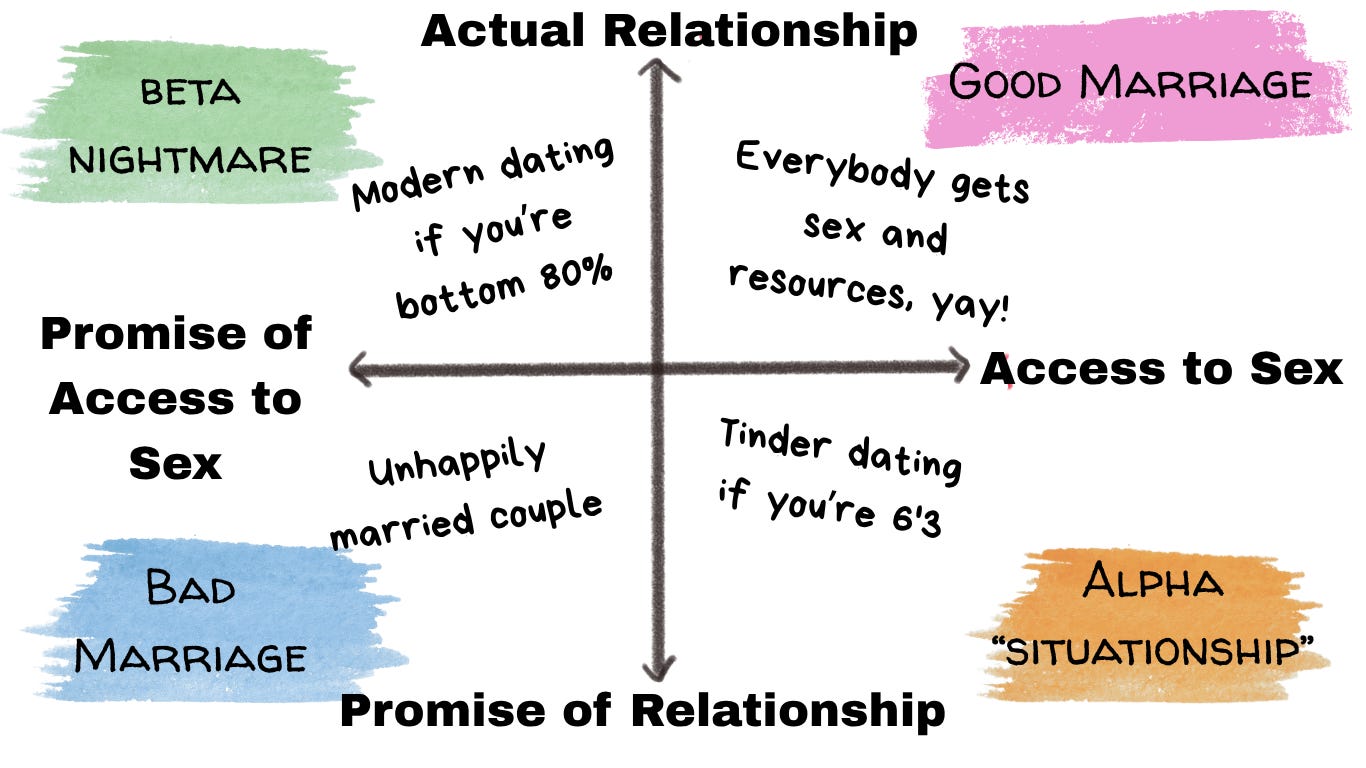
Dating is fake and gay, especially when it’s done by teenagers. It is an exchange that allows young people to ape the functions of heterosexual pairing, i.e., marriage, in a way that: (a) generally only benefits one of the parties involved, and (b) doesn’t benefit society, period.
Men and women get married for different reasons. For women, marriage offers protection and resources for themselves and their offspring. For men, it offers sex-on-demand (your wife is like the beer in the garage fridge…convenient and ice-cold a known quantity), a caretaker for his home and children, and—this one is really important—paternity certainty. When we have paternity certainty, everybody wins, especially the offspring of such unions, who get resources like food and piano lessons. We also get civilization.22
What’s so wrong about dating? Isn’t it simply a mechanism for assortative mating? No: that would be something like the custom of arranged marriages or courting. Courting, for all its lame and LARPy connotations, really just means that the entire family is involved in the process of finding a suitable marriage partner for one’s children. Dating is the real LARP: the girl gets to pretend she’s in a relationship with someone who will take care of her material needs, and the guy gets to pretend someone is willing to touch his genitals. The public rituals of dating reflect this: the picture a young woman being taken out to an expensive restaurant (look at my resource-chimp acquiring food for me!) while the young man holds her hand with a casual, knowing grin (“Who, me? Why yes, I am getting laid later!”)
Why am I taking issue with such innocent, youthful diversions? (What, didn’t you read the quadrant chart?!) First, because it’s all too easy for this kind of LARPing to turn into something unhealthy and psychologically damaging. The girl may take advantage of the young man: she may allow him to expend an ever-increasing amount of his resources on her, though she has no intention of having sex with him, let alone marrying him and having his children. The guy, on the other hand, may use the girl for sex with no intention of caring for her in the long run (either emotionally or physically; plus, he might leave her with a lovely parting gift, such as Chlamydia). This dynamic tends to shift with the age of the participants; young women overwhelmingly have the power advantage over young men; meanwhile, women, as their youth diminishes, slowly find themselves at the mercy of lower quality chimps, er, men.23
The Eternal Maiden
Nature gives us nothing for free. Maidenhood, as with every other phase of life, is there to serve a very specific purpose: to bring motherhood to fruition. It was the means by which motherhood was to be acquired: a phase of ostentatious fertility. In nature, Maidenhood had a natural and unavoidable expiration date. In a modern world of birth control, however, it may be extended indefinitely.
Eternal Maidenhood is a world of endless possibility. It provides great swathes of time for self-care routines and boozy brunches—or, if you’re not that kind of woman, time for Serious Pursuits like earning a Ph.D or product liability suits or becoming the single worst presidential candidate in U.S. history. Even when women choose to add children to their already full to-do lists, they still strive to emulate the lifestyle of the Maiden. To do anything else is coded as low-status.
Watch any movie: it is the maiden who features center-stage. It used to be that she would always be youthful; plausibly unmarried in spite of her good looks. Now we have maidens of all ages: middle-aged women and post-menopausal women and single mothers back on the dating market.
Mothers are conspicuously absent or unimportant. They represent constraint and obligation, and tend to feature as well-meaning antagonists trying to clip the wings of the maiden-character. Sometimes they’re supporting characters who conveniently die right before the third act so that other people are able to develop their full potential as human beings.24 We may have sentimental attachments to her, but she serves as an uncomfortable rebuke to the maiden’s desire to live her high-risk, low-obligation lifestyle.
Nobody wants to relinquish maidenhood. Mary Harrington writes:
“The maiden rejects the idea of letting time flow on: she bridles at any suggestion that motherhood is full of pleasures, or that the passing bloom of youth and beauty is a fact of life and biology, rather than a cruel injustice perpetrated by sexism.”
And so society offers women an appealing alternative: the life of Eternal Maidenhood. For Women of a Certain Age, this fantasy is as dangerous as it is seductive, because it ultimately cannot deliver on its promise of eternal youth. Sure, with enough money and discipline—plus a dash of luck in the genes department—one can stave off some of the effects of aging. But the illusion of youth is just that: something you can sell for a little while under low-light conditions. Eventually, even the illusion falters.

The C-Word
That brings us to the Crone, or Matriarch.
For some women, this can be a terrifying transition. Your bank account is empty. You’ve spent your entire life with that unearned, unasked-for fortune, and you’ve kind of gotten used to having it. Now you must learn to navigate the world without it.

I’m a few years off of this phase, but I’m going to throw caution to the wind and dispense some advice anyway.25
This is not the time to cower in your empty bank account, pretending you still have money or fondly recalling the days that you did. You’re penniless. You’re Gloria Swanson in Sunset Boulevard. You can either shrink from the world or go out into the wilderness with a sharpened stick. This is your final passage: the Ordeal of the Crone.
You’re like the 13 year-old boy stripped naked and sent into the wilderness. You have none of your familiar comforts and nobody is coming to save you. You will try or fail on your own; you must navigate the wilderness, knowing that many before you did the same, and that some never returned.26 If you’re strong enough, you emerge after three (metaphorical) days and nights stronger, more confident, more sure of yourself and your own worth.
I often come across articles about what it’s like to be an aging woman. The number one complaint is, “I feel invisible.” I would like to suggest that if this description fits you, then you view this as an opportunity, rather than as a punishment. The male gaze is a thing of the past. You are now able to experience the world without any intervening sense of being seen. There is no mirror in the way; you can finally see past your own reflection.
The tragedy of Toxic Maidenhood—and its false prophet, the Eternal Maiden—is that it robs women of their true potential.27 Women are presented with a tantalizing option: the promise of eternal youth and unbounded freedom. The cost is a spiritual hobbling that permanently renders her as shallow and self-conscious as a fourteen year-old girl. Unless society can restore honor and status to the Mother—and yes, even the Matriarch—this will be, for many women, a temptation too great to pass up.
People seem bothered by the c-word. Suffused with an unexpected burst of Anglo-Saxon supremacism, I was getting ready to launch an argument in favor of its rehabilitation…and then I learned that it comes from the Anglo-Norman carogne, from the Old French charogne, which means “carrion, carcass, old sheep, hag”). I’m not going to go around calling post-menopausal women carcasses on behalf of the damned Northmen Normans.
Adds needle-pointers and Sudoku-enjoyers to Enemies List.
Look, I know there are religious homeschool co-ops and schools in which this is considered a normal and acceptable opinion, but I’ve never made it past the “You Need to Sign A Statement of Faith about how Dinosaurs are Fake & Gay” gate, so I’m not as familiar with this social milieu.
I’m not going to link to this. Just look it up for yourself, pervert.
Many of which will not involve clothes.
As in, not dysgenic-looking.
It’s not that I never meet teenage girls who are excited about the prospect of growing up to become moms. But they’re rare enough—or at least the vocal ones are rare enough—that I can count them on the fingers of two hands.
You can usually tell by the locations and content of her tattoos.
And the hotter they are, the lower the expectations.
Their husbands, unfortunately, must either placidly accept being spiritually cuckholded, or learn to keep them on a very short leash and get a reputation for being controlling assholes.
Based on years of collecting unscientific anecdata.
There are two psychological tendencies at play that, when paired, create a disastrous situation: (1) a need to be seen and admired, and (2) a desire for novelty. Women with these traits tend to be serial monogamists.
Ladies, all of you have a friend like this (or maybe you are this friend; come on, a little self-knowledge won’t hurt). She’s the one who is always on the heels of a messy break-up and is just starting a new relationship with a man whom she insists is her soul mate. But if you give it a few weeks, or a few months, she will discover that he has some serious, unresolvable personality flaw; or he just doesn’t give her butterflies anymore. She loves him, but she’s not in love with him.
Translation: she has her eye on a newer, better prospect. If she has low impulse control, she’ll simply cheat on her current boyfriend, perhaps with a flurry of rationalizations or tearful mea culpas, but never with any sort of genuine remorse. If she has a greater degree of self-mastery, she will construct an elaborate exit strategy that will leave her looking like the victim to all outside parties, including potential suitors.
For a more detailed explanation of this phenomena, please read F. Roger Devlin’s excellent red-pill speed-run, “Sexual Utopia in Power,” archived here:
https://www.toqonline.com/archives/v6n2/DevlinTOQV6N2.pdf
I’m not saying that every man is a cad and every woman is a whore. Both men and women are capable of controlling their instincts. But it helps if society doesn’t leave it all up to them. As anyone who’s ever tried to stop eating sugar knows, willpower only gets you so far. If you walk by a freezer full of ice cream fifty times, you may just cave in on the fifty-first.
To all those in the women-are-naturally-monogamous camp: while I appreciate your vote of confidence, I think that women’s track record of staying by their husband’s sides has less to do with some inborn drive and more to do with practical calculations. Throughout most of history, leaving your husband—especially if you had children—was accompanied by severe penalties, ranging from legal sanctions (up to and including death) to the natural consequence of being destitute and/or a social pariah.
This explains why, as the practical and legal consequences of leaving one’s marriage have evaporated in modern society, divorces—the majority of them initiated by women—have become more common. To the extent that divorce is not as widespread as one might expect, this is a reflection of the remaining practical considerations combined with the lingering social stigma of divorce. (Which would also explain why divorce is less common among populations with higher impulse-control and more common among those for whom the stigma of things like playing your bluetooth speakers loudly in a public park or changing your baby’s diaper atop a table at McDonald’s, is less persuasive.)
This really isn’t much of a flex, but from the time I had my first child, back in my twenties, to the time my youngest was old enough to go off and do things independently—and that was a span of 15 + years—I was almost never alone with an adult man to whom I wasn’t biologically related. It wasn’t even a conscious policy: I just had young kids, didn’t work outside my home, and didn’t have friends who weren’t other moms.
Will Durant, of The Story of Civilization fame, has an out-of-print book with any number of now-forbidden observations, such as:
“Men may be friends, but women can only be acquaintances. When women speak well of other women the stars are disturbed in their courses. they find it difficult to entertain themselves; they are bored to desperation in one another’s presence, and can bear it only by talking of men. And it is all very natural; as La Rochefoucauld long since noted, ‘The cause why the majority of women are so little given to friendship is that it is insipid after they have felt love.’ Love, as the poet said, is for man a thing apart, but it is woman’s whole existence.”
(Will Durant, The Mansions of Philosophy, 178.)
C.S. Lewis, The Four Loves, 98.
Durant, The Mansions of Philosophy, 205.
Enable by birth control.
I’m a Tevya apologist.
See R versus K mating strategies.
And wouldn’t you know it? Arthur Schopenhauer has something to say about this:
“In the girl nature has had in view what could in theatrical terms be called a stage-effect: it has provided her with super-abundant beauty and charm for a few years at the expense of the whole remainder of her life, so that during these years she may so capture the imagination of a man that he is carried away into undertaking to support her honourably in some form or another for the rest of her life, a step he would seem hardly likely to take for purely rational considerations.” (81)
For the record, I think this is an incomplete picture. Someday, we’ll return to this topic, and we can discuss a philosopher with a more nuanced view of women, like…Nietzsche.
Nothing ruins a Hero’s Journey like your mom.
And if I turn out to be wrong, I’ll issue a full retraction.
These, I imagine, are the middle-aged-and-above women who plunge fully into self-delusion, plastic surgery, and the desperate clinging to the rituals and lifestyle of youth/maidenhood.
Yes, I know I’m doing the meme: “Sexual morality discarded; women hit hardest!”
Cronehood is scary because y'all don't have enough aunties.
I have always looked forward to it (nearly there!), because my grandmother and her sisters were a big part of my childhood, and they were the greatest people on earth. What I grew up knowing was: once you get old, you know everything, remember everything, have permission to say anything, and are free from the current rules of fashion (which are invariably oppressive and uncomfortable). And you have cake.
I am soon to be 56, married thirty years, mother to six, grandmother to 2 and more, I hope. Fully a matriarch. I can relate to that feeling of being invisible bc I feel the same on the inside, like I'm still just me. And for a long time that me was young! That was only weird for a little while, and now I love it. I am much more relaxed and confident.
Also, I find that the struggles and storms of my 20s and 30s have passed, and that gives me a lot of compassion for my kids and their peers. They still need me-- to be a listener and a cheerleader, to be someone to tell their frustrations and fears, to try to be the voice of ongoing love and acceptance. And my husband still needs and loves me.
And who is going to pray for each member of this family every single day, if not the matriarch whose whole life built it up? Any schmuck can discover the cure for cancer. I, with my husband, under God , am building society.